
Mass Migration
And World History

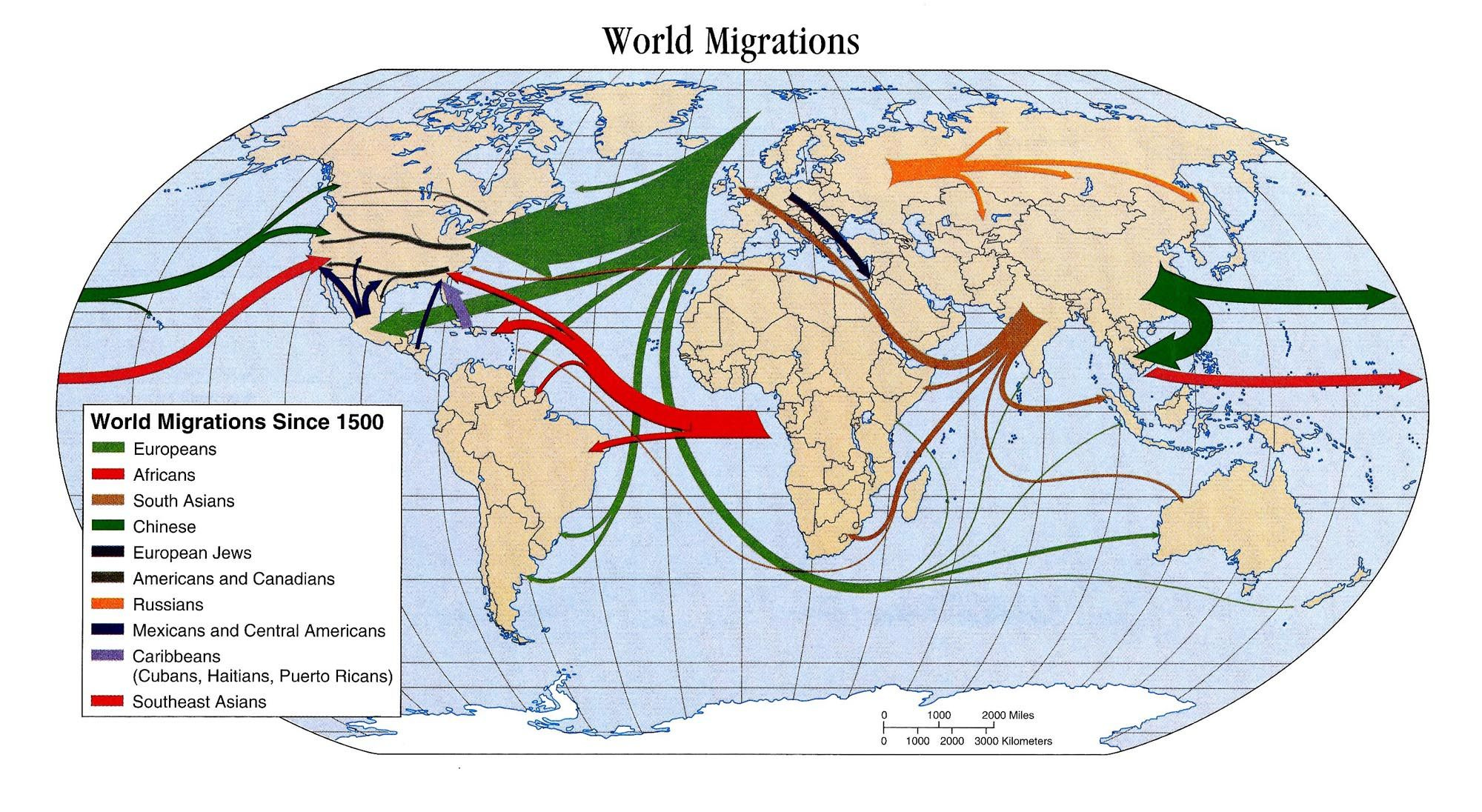
Mass Migration and World History
Mass Migration is something that happens from time to time. Looking at history, something broadly resembling a mass migration normally takes place every few centuries. And it is generally a bad and dangerous thing for everybody involved. It is usually generated by very bad living conditions in one place, and/or an opportunity to obtain better conditions elsewhere. Some mass migrations are peaceful, though most end up being done at least partially through the tip of the sword. Sometimes there is a great disaster that people flee from in mass. They generally either have enough swords or gold to find a new place to live, or they are slaughtered or enslaved by the people who live where they are going. Other times, an organized and powerful realm has a lot of bored strong young men without much to do so the leaders decide to give them something to do. Go over there, and take the land from those other people, take their women, and make babies for the glory of our land.
Either way, the bored strong young men aren't trying to lure the sweet young wives and daughters back home away from the comfortable fires of family and the more established people it would be much better for them to make families with. The key point in more organized mass migrations like this is that the rich people in power are insulated from the effects of the migration, while it is the poor people who do most of the fighting and dying and risking of limbs. They either do it because they are told to, or because their realm will recognize any land (and women) they conquer as belonging to them. Dreams of free land and women have tempted many bored young strong men into migrating to foreign lands to make it rich. That in fact is one of the greatest cycles of history across the world. Every square inch of ground on Earth, except perhaps for Antarctica, has seen migration in action. And if you go all the way back to when Antarctica was warm and part of Pangea, I’m sure it happened back then too. We can see evidence of these mass migrations in the dirt if we know what to look for. People are digging it up all the time.
The Sea Peoples that appeared out of nowhere in the Mediterranean were almost certainly a form of mass migration. Our records of that era, centuries before the birth of Christ, are fragmentary, and we don't even know where they came from. All we know is that they showed up one day and everyone lived to regret it. The civilizations of the area had a complex trading relationship with each other, and they sent letters everywhere. The letters we've recovered tell the tale of a complex network of advanced kingdoms. And then one day some of them fell silent. Some sent pleas for help, or words of warning, because people arrived from the sea and overwhelmed them. The letters came one after another, from one end of the sea to the other. One of the most poignant letters we've found is a report from the Egyptian army that they won. The Sea Peoples had been defeated. And the Egyptian's own losses were so horrible, so vast, that they didn't know if their army or empire would survive to celebrate the victory.
The Roman conquest of that same area centuries after the Sea Peoples disappeared into history certainly had aspects of mass migration. Roman Citizens could go anywhere they wanted, and they did so in peace after the Romans armies killed enough locals to teach them what happened if they resisted. The Muslim conquest of three-quarters of the Roman Empire was absolutely another example that could fit the definition in broad strokes. The Mongol Hordes that road from one end of Asia to the other and even brought the last remnants of Pseudo-Roman power low were another. The majority of the people in the world actually share DNA going back to those Mongolians, showing just how intimately their strong young men migrated when they came to a new land.
The European Colonization of the Americas was a major mass migration that ironically has its roots in the Mongol Hordes that drove the previous major mass migration. When the Mongols conquered most of the known world and united both the West and the East in one large economic region, they brought Asian germs with them that became the Black Death, a plague that killed somewhere around a third of the European and Middle Eastern populations. Tens of millions of people died, civilization as we knew it collapsed, and only the fact that Northern Europe is a cold and uncomfortable place to live allowed the European survivors to rebuild.
The Europeans who did rebuild sported immune systems capable of fighting way more diseases than their ancestors. They were made of hardier stock, a factor they would use for generations. The Europeans that traveled to the Americas centuries later brought their germs with them, and the people they named Indians had been separated from their Asian cousins for what most people think is thousands of years. They had no defense for the Black Death or the stew of other diseases brewing in European immune systems. Multiple pandemics flew up and down the Americas, each one wiping out a quarter or half of the local populations. Estimates suggest that the populations of the Americas were in the millions to tens of millions when the plagues began. That is how many died in the end.
By the time settlers arrived in New England, scattered Indian tribes numbering in the thousands or tens of thousands were all that was left of those who tended and gardened the ruins of the civilization their fathers, grandfathers, or great grandfathers remembered. The religious exiles that would later create the United States of America found a new-to-them Promised Land of immense riches and very few Indians to defend it all. That made our colonization of the Americas one of the more successful mass migrations in known history.
The United States had a saying in the 1800s. Go West Young Man. Many historians consider it part of the movement that said the United States had a Manifest Destiny to spread the ideas of Republicanism and Christianity across the continent. It started with the Louisiana Purchase from France that doubled the size of the country all the way to the Mississippi River and opened up new opportunities of cheap land for brave young men trapped in the crowded, expensive, and already built-up Colonies on the Eastern Seaboard.
The Great American Migration built St. Louis into a prosperous center of the immigration pipeline, and hundreds of thousands of strong young men and women moved west to get their piece of the American Dream. Some land, a cow, and a home of their own, be it ever so humble. Tens of thousands died of disease or fighting Indians in Oklahoma, Minnesota, Texas and many other lands, but when only one in ten of a mass migration dies, that leaves the other nine to settle the land, whether the locals want them to or not. They built America into a continental powerhouse with a steadily expanding industrial base that formed the core of the America we know today. We built this land through the simple expedient of organized mass migration.
Mass Migration and the rise of England
As the Roman Empire began to fall, chaos ruled the northern edges of civilization. Barbarians waged war both each on other and on Rome, and things did not go well for many. Others saw a chance to create a new life for themselves. Many people from the area that would later be called Germany traveled to far off Britannia to find exactly that. It had all the hallmarks of Roman civilization from good waste disposal to well-tended farmlands.
The people history would call Jutes, Angles, and Saxons escaped the ravages of continental life for life on an island. But the Roman province of Britannia was home to between 2 and 4 million Britons in the year 400, and most of them did not return to Rome. Only the big rich and important Romans did that. So the Britons were left alone to face the tide of new arrivals. Some legends tell tales of a King Arthur-like figure who rallied the Britons and held back the invading Saxons for a time. Most historians think there was some truth to that legend. Some form of a Kingdom of Summer, or whatever name you want to give it. The Knights of the Round Table probably a myth, but the best myths are based on a kernel of truth, so there could be something buried in history that we do not know. Whatever the case of this, it did not last, and those who fall rarely get the chance to write the history books.
Between 20,000 and 200,000 Saxons moved to the island based on computer estimates. That puts the total mass migration at between less than 1% on up to a possible 10% of the local population. Those mere tens of thousands of Saxons ruled Eastern and Southern Britain by the year 500. The last Celtic king ruled the lands of Britannia around 700, and by around 800, only the Saxons remained throughout what we consider modern day England. What Britons and Celts still existing in those lands were “encouraged” to take on Saxon names and to speak Old English. The Saxons absorbed them and their old traditions either adapted or died.
Vikings were the most dangerous brigands of the Old World in the centuries after the fall of Rome. They liked to think of themselves as more traders than brigands, but were not above liberating things they wanted from people who lacked the strength to stop them. They were rather unholy pagan terrors of Britannia, France, and what would become the Germanies. They even effectively conquered much of northern France and laid siege to Paris itself. In the end, the French king and one of the Viking leaders came to an agreement. His Vikings would stop their brigandly ways, swear fealty to the king of France, convert to Christianity, wed a very nice young lady of noble birth, and most importantly of all, stop all those other Vikings from stealing all of France’s stuff.
It was actually a pretty easy decision for the Vikings. Northern France was a vacation destination for Vikings who didn’t feel like freezing their balls off every winter, and the weather is barely noticeable to a North Man. But it was a storm-swept Hellscape for the French, so they were happy to give it up if it meant no more Viking raiders attacking Paris. At which point the Normans became France’s best guard dogs.
They left their pagan ways behind and signed up for that Christian God thing. They started speaking French. They learned to like cheese and croissants. They even learned how to do that little pinky thing while drinking tea. Or whatever the French drank back then. Probably wine. Either way, the Normans went to town welding themselves into the highest ranks of local society. If a local ruler had a daughter or son looking for a spouse, the Normans had someone ready to sign up for that. Those Norman kids went everywhere, and treaties and alliances went with them. They are one of the reasons that European royalty are all kissing cousins now.
The North Man’s “settlement” of Normandy is one of histories most successful examples of a mass migration where the immigrants joined up with the locals rather than wiping them out. They became the rough and tumble guards of civilization, and France became the united France we think of now because of the Normans. And if you know French and English history, you know what I just did there...
Death comes for everybody in time. Every nation. Every person. None of us will live forever, despite our greatest wishes or plans. Don’t get me wrong. I’m still seeking that whole immortality thing, but humanity is shooting at darn near 100% on missing the mark so far. And as in all things, death came for the descendents of the Saxons who conquered the former Roman province of Britannia. Or at least their ruler at the time.
And whenever there is a death of a crown, there are claimants for the crown if there is no set line of succession. Sometimes even if there IS a set line of succession. Some people will do anything not to lose out on a game of thrones after all. This is the way it was when the king of Saxon England died. Prospective crowns came out of the woodwork, as well as invaders who sought an opportunity for new wealth and new lands. The Saxons got it all, good and hard. And they fought, good and hard.
The most successful of the claimants were the Normans. They were married into basically every royal family of Europe by this time, and William the Conqueror thought his claim was solid gold. So he assembled the largest fleet ever put to sea to cross what history calls the English Channel to bring an army capable of defeating every Saxon army he met. He plopped his butt on the throne of England and decided that he liked it there. He was going to stay. And he brought all of his favorite and best Norman nobles with him to become the new ruling class of England. This was a mass migration of the nobility, and it would forever change the destiny of the British Isles.
The Normans ruled England with somewhere between an iron fist and a velvet glove depending on who you ask. The Saxon accounts in general hate them. Robin Hood has become a legendary dogooder throughout the English-speaking world for a reason. In most versions of the tale, he was a Saxon stealing things from the rich Norman nobility and returning the stuff to the Saxons they stole it from to begin with. On the other hand, the Normans never committed a widespread eradication of the Saxon people. They never even banned them from speaking what we now call Old English, even as the Normans continued to speak French.
Then one day the French monarch died. And wouldn’t you know it, the Normans were married into that royal family as well, and they wanted a piece of that action. The French had not forgotten that the Normans were just jumped up Norse raiders with delusions of grandeur though, and they refused to be ruled by such barbarians. The very divided French kingdoms of the era could agree on that point at least, and they went war to support their fellow Frenchmen over those jumped up Normans.
The Normans rather quickly realized that they could not win against a unified France, but they were not about to give up on their dreams. They needed more manpower, so they went to their Saxon underclass looking for more warriors. And what were those lower-class poor who were banned by Norman laws from possessing good steel weapons really good with according to every Robin Hood story we know? The bow. Well, the Normans asked their very good Saxon friends if they wanted to go shoot some French. And the English Longbowmen became the terror of the continent throughout what Historians would call the Hundred Years War.
France drove the Normans from Normandy in the end, and the Normans settled down in England. And in a hundred years and five generations of fighting the French, the Normans did what they did in France. They assimilated with the locals. They began speaking English, but not every word of French disappeared from their vocabulary. Many still remain. But that was the final result of the North Man’s mass migration from their Viking homeland. They disappeared into the land of England and just settled down. They assimilated, but they also left their mark on the lands they settled while doing so.
Mass Migration and the Rise of Islam
The Arab invasion and eventual conquering of three quarters of the Roman Empire was one of the most successful mass migrations of all time. It started out beyond the fringes of the Empire in the Arabian Desert when Mohammad first united the Arabian tribes into one coherent army under his command. What followed was a lightning campaign, by historical measures, that conquered all of the Eastern shores of the Mediterranean, North Africa, and the Iberian Peninsula from the Roman Empire in approximately a century. The also destroyed the Persian Empire and their conquering armies traveled all the way to India in the East. It took the proto-French cavalry to stop the invasion into modern-day France, and that saved the rest of Western Europe from a major Islamic invasion for the next millennium and more.
The Arabs settled into and ruled the lands they conquered, and from that time on they kept track of who was Arab and who wasn’t. Who was Muslim and who wasn’t. While other races and religions were officially tolerated in their lands, they were distinctly second-class citizens at best. They converted churches and temples to Muslim worship, and their raiders landed on European, African, and Indian shores alike in search of new slaves. They turned the men into eunuchs and placed the women in harems, effectively erasing the enslaved populations from history by the simple expedient of ending their family units.
The Arab mass migration effectively wiped out the cultures and peoples that existed before their arrival, elevated their own culture above all others, and recreated the very land in their image. This mass migration is one of the most consequential in human history and has changed the world like few others.
It was not one hundred percent effective though. The French, the Eastern Roman Empire, and the Indians drove them back from their core regions of power. But not before they converted a large number of mountain Turks to their new religion. Then the Mongols drove into Europe and the Middle East and brought the Black Death that wiped out between half and a third of the local populations before disappearing back into the East.
The Turkic tribes of the high mountains walked into that power vacuum with a smile. The Afghan Turks conquered most of India with the help of Persian Turks while Anatolian Turks conquered the plague-weakened Eastern Roman Empire, including Constantinople. The new Ottoman Empire quickly controlled three quarters of the old Roman Empire, from South-Eastern Europe to North Africa, while their fellows ruled modern day Iran and India as well.
And the Turks ruled in a rather de-centralized manner over the regions they conquered. They weren’t even all allied with each other. They fought and betrayed each other almost as much as they fought with Europeans in fact. Maybe more. The next few hundred years have more rising and falling tribes and peoples than European minds are really equipped to understand. For us, the French have been French for a thousand years, and the Gauls before them were kinda proto-French. Ditto the Germans, the Poles, the Scandinavians, and the Russians. But the various Turk and Turk-adjacent and Resisting-The-Turk tribes and peoples seem to remember all of it, and can tell you in detail every single one of them. Every time they were on top and every time those people two villages over were on top. It is just one long series of migrations from place to place as the tribes wax and wane in strength.
The expansion of the Ottoman Empire was a bit of an odd duck when it comes to accompanying mass migrations. They conquered much of South Eastern Europe, South Western Asia, and the old Arabic Caliphates in the Middle East and the North African territories. Some of the mass migrations, like those into Europe and Asia, are easy to see in the styles of buildings and mosques that exist to this day. Or in some cases don’t. Other mass migrations like those into and out of the Arabian and African regions are harder to track.
The exact reasons for this are relatively unclear. Did they move in and then leave again, or did they never move in more than a few basic administrators to watch over the conquered territories who were later absorbed into the general population? The predominant faith of both ethnic groups was Muslim by that time, so the religious wars that took place were more disagreements between the different flavors of Islam, and those flavors crossed ethnic borders. This all makes mass migrations in those areas a bit harder to track.
There are basic types of architecture that are famously Ottoman that can be seen throughout the old Ottoman Empire. Experts can easily recognize a surviving Ottoman government building, but the Turks themselves were far more willing to pull up stakes and move somewhere else than their European counterparts. And the modern Middle East and North African nations they once controlled exhibit a distinct lack of respect for or influence from their former rulers if you ask the modern day Turks.
The Turkish mass migration into South Eastern Europe is obvious for all to see, both in the coming and in the going. At its height, in the general 1600s to 1700s era, the Ottoman Empire controlled most of it, and the Turkish Muslims moved in to take over local Christian churches and turn them into mosques. The European Christians did not greet this with friendly eyes. The Turks faced opposition from the Holy Roman Empire and its allies and vassals, and it was a full scale holy war between the polities that lasted for centuries. The kind of treatment Vlad the Impaler is famous for is one example that history remembers of this time, but was not at all one of a kind. The Ottoman expansion was famously halted at the walls of Vienna when the Polish Winged Hussars broke the Ottoman assaults.
The various European powers then spent a long and slow march going from Vienna to Constantinople that took centuries. It even included a series of revolutions when captive populations in the Balkans broke free of their Ottoman overlords. Many of the Turkish Muslim populations migrated back into modern day Turkey during this long series of reversals. Sometimes willingly. Sometimes to escape with their lives ahead of the executioners who remembered what their ancestors did to their ancestors. In some regions, you can still see their influence today. In others you absolutely cannot. Neither are an accident.
Mass Migration and the Fall and Rise of Russia
The history of Russia is not well known in Western histories. They first came together as a collection of Slavic tribes centered around Kiev who called themselves the Rus. They commanded most of Eastern Europe beyond Lithuania, Poland, and Hungary. The Mongolian horde crushed the Rus, drove them north, and forced them to pay tribute. Moscow rebelled in time to form the Russian Empire and they considered it their duty to retake all the lands they lost and to drive all the way back to Mongolia to make certain the Mongols didn’t do it to them again. They also drove west into what we now call Eastern Europe and fought a long series of wars with the European powers over the lands they wanted back. And maybe a little bit more to act as breathing room for their people.
The Russo-Ottoman Wars are also not well known in the West. Both the Russians and the Turks were rising powers when they met. Sometimes the Russians won. Sometimes the Turks. But as time went on, the Russians marched south through all the lands they lost. Some names from that time resound even in our own ears. Ivan the Terrible. Peter the Great. Kiev. Ukraine. Sevastopol. Crimea. The Russians spent literal centuries retaking their lost territories and more. They didn’t want anyone driving them from their lands. Again. And just as the Turks moved into a region they conquered, so did the Russians. And neither side was keen to let the other remain settled in a land they conquered. Forced conversions or executions were common on both sides. And as the Russians advanced, most of the Turkish Muslim populations migrated back into modern day Turkey. Sometimes willingly. Sometimes to escape the executioners.
Both the terms mass migration and a newer term genocide describe the population movements along the shifting frontiers over the centuries, and neither the Russians, the Europeans, or the Turks were shy about implementing either. One might even call that entire mess we call Eastern Europe the result of weaponized mass migration.
Mass Migration and the Rise of the Spanish Empire
The war between the Spanish Empire and the Ottoman Empire is one of the great global conflicts of the early modern era, seeing direct conflict in Europe, Africa, and Asia, with the Americas contributing a critical amount of wealth to the conflict. It started a hot minute or three after the Spanish and their Portuguese allies drove the last of the Muslim kingdoms out of the Iberian Peninsula. After the better part of eight centuries of enduring the initial Muslim invasion and the long Reconquista to retake their lands, the Iberians had no intention of allowing another invasion to happen. The Portuguese quickly expanded into the open seas to create a new economic empire covering Southern Africa and Southern Asia and the Spanish walked into the nearest Muslim kingdoms in North Africa with blood in their eyes. Those kingdoms asked the Ottomans for help, and it was on like Donkey Kong.
Their allies in the Ethiopian Empire and the Holy Roman Empire fought sporadic hot and economic wars in Eastern Europe and the Horn of Africa, while the Portuguese and Spanish sailed all over the world to fight the Ottomans and their allies and proxies wherever they found them. Barbary Corsairs. Arabian Raiders. Indian Sultanates. The Sulu Sultanate of the Philippines. They claimed the Americas, found vast wealth there that helped fund their global conflicts, and the sun never set on the Spanish Empire centuries before it never set on the British Empire. The Ottomans maintained effective control of the Eastern Mediterranean despite constant Iberian pressure, but the Iberians fought the Ottomans and their various allies from Africa to Europe to India.
And everywhere the Spanish and Portuguese armadas and armies went, so did their treasure hunters, priests, and settlers looking for new opportunities. It was a mass migration of millions of Spaniards into the new worlds. At least five million Iberians left the peninsula over the next four centuries. That was a statistically significant amount of the total population of Iberia, and it remade the New World, especially after Old World diseases wiped out millions of the native populations in the New World, and millions of slaves from Africa were imported to replace them. Expanding Hispanic populations created the dominant cultures throughout South and Middle America, and as we all know, much of Southern and Southeastern North America also came under their sway.
The Iberian Mass Migration effectively remade the world in their image, and is one of the most consequential mass migrations in known history.
Mass Migration and the Fall of the Ethiopian Empire
Ethiopia is one of the oldest civilizations in Africa. Whether you call it Abyssinia, D’mt, Aksum, Ethiopia, or one of the many other names littered through history, civilization in what we now call the Ethiopian Highlands stretches back thousands of years, and was famous all over the world. It never fell under the direct power of Rome, but its ships and ports traded with Rome and all of the other great empires of the day. And it was one of the first nations to convert to Christianity. The later Arab invasion that shattered the eastern and southern Roman Empire cut Ethiopia off from the rest of the Christian nations.
It became a hidden empire of lost Africa, and many Europeans forgot it even existed. It may have been forgotten, but Ethiopia did not die. It continued to survive in the forested and mountainous region often called the Roof of Africa, even as the Arabs and later the Ottomans invaded and took control of Ethiopia’s rugged coastal regions. The Ottomans even drove into the Ethiopian Highlands to kill every Christian they could find, but the Ethiopians and their Iberian allies drove the invaders out. Fighting would continue over the centuries that followed as the Ottomans, the Sudanese, the Egyptians, and numerous others fought with Ethiopia and various European powers over control of the coasts.
The Ethiopian civilization has jealously guarded their access to the ports they have used to trade with the world for thousands of years. And of course everybody else wants those same ports as well, because they are rich ports all around the Horn of Africa. But the various invasions and wars were accompanied by mass migrations of people from modern day Arabia, Sudan, Egypt, and many other nations. Ethnic Ethiopians were largely driven out of their coastal regions, and though Ethiopia has fought many wars over the last several centuries to regain control of them, they have been driven back out each time.
The coastal regions of Ethiopia are now officially known as Eritrea and Somalia. They are the product of over one thousand years of mass migration that drove the indigenous African civilization out of their traditional trading ports and replaced it with a traditionally Arabian culture that has been trying to eradicate them ever since. That is mass migration at work.
Mass Migration and the Rise of the British Empire
The rise of the British Empire set off another of the great migrations in history. England’s early expansion was slow and fitful, mainly involving the general conquering of the other nations in the British Isles. They did plant some other colonies, but the British Empire didn’t truly exist until after they fought off the global power of the other European powers. All of the great European naval powers had established trading routes throughout the world, and they fought over control of them for centuries.
The British Empire we recognize began taking shape in the 1600s, with the colonization of the America’s, but it was the War of the Spanish Succession, the Anglo-Spanish Wars, and the Seven Years’ War in the 1700s that truly cemented its position as the preeminent empire of Earth. Their recurring conflicts with Spain ushered in the decline of the Spanish Empire that had fought the Ottomans for so long, while the Seven Years’ War between England, France, and the other major European power raged across every inhabited continent on Earth. America knows it as the French and Indian War, but it was possibly the first true world war.
The sun never set on the British Empire that emerged from that conflict. It’s early industrial progress allowed over twenty million English to board ships to colonize the world. And where the English went, so did their laws, navy, army, and their traders and bankers. They built a legal and trading network that spanned the world, and English became the language of trade. English suits became the clothing of the world’s wealthy, and English culture spread throughout the world. Even the fall of the British Empire in the 1900s did nothing to change that, as the United States took their place in backing the legal and economic network they built for the next century.
Much like the Iberian Mass Migration changed the world before it, the English Mass Migration remade the world in England’s image, and is very possibly THE greatest mass migration in history.
Mass Migration and the Fall of the Ottoman Empire
The Ottoman Empire was failing in the early 1900s. It had been fading for centuries in fact. Prolonged wars with the Spanish Empire, the Russian Empire, the British Empire, the Ethiopian Empire and just about every other empire worthy of a name had left its coffers empty, its strength spent, and Constantinople itself, once the throne of empires, was a flee-bitten rat warren compared to the great cities of the other world powers. The Ottoman Empire was dying.
North Africa was lost. Greece and the other Balkanized nations north of it had rebelled. The Persians were a threat in the east, the Russians wanted a piece of them from the north, the Ethiopians were none too happy to see the Ottomans controlling their port cities, and the Arabs were rumbling discontented murmurs. The Young Turks took power, relegated the Sultan to a figurehead status, and determined to deal with any other threats to the remaining power of the Ottoman Empire.
The Armenian Christians were exactly the kind of threat they saw all around them. The Armenians had been absorbed into the empire centuries before, but they still controlled much of the northeastern frontier between the Ottomans and the Russians. The Young Turks thought the Armenians could rebel like the Greeks, switch their allegiance to the Russians, and give the Russians an invasion corridor directly into the Ottoman heartlands. That could not be allowed, so the Young Turks decided to eliminate the problem the old fashioned way.
The best way to remove the Armenian problem was of course to remove the Armenians. The Ottomans had already gotten a head start on that problem by killing hundreds of thousands of Armenians in previous purges, but the Young Turks intended to go all the way. They sent their troops to confiscate the Armenian lands and force-marched the Armenians out of their comfortable homelands into the deserts of the southern Ottoman Empire. Somewhere around one million Armenians died either in the marches or the concentration camps they ended up in, and hundreds of thousands more were forced to convert to Islam or die. A similar number of Greek Christians were killed, effectively ending two thousand years of Greek and Armenian culture in the area.
The Ottomans then moved their own people into the devastated region with a kind of mass migration, and that allowed them to form modern day Turkey as an ethnocentric Muslim State. Modern day Turkey calls it a simple deportation. One might even use the term involuntary mass migration if one was feeling less supportive.
A European Jew invented a new word to describe what happened to the Armenians, as well as his own people in later decades. Genocide.
Mass Migration and America
America has a complicated relationship with Mass Migrations. The fact is that we love them. We wouldn’t exist without them. We were born of a mass migration started by people who wanted religious liberty and built a nation that enshrined it in the highest laws of the land. And though it took us over a century, we built an economic powerhouse that helped lift the world out of poverty and war via continued mass migration.
And even now our companies are always looking for new workers willing to work for less money than someone who grew up in America. Illegal mass immigration into America didn’t start four years ago. Or twelve. Or twenty. An estimated tens of millions of illegal aliens already lived in America when I was young and Reagan was president and the first big border bill compromise between Republicans and Democrats was signed. Republicans promised and delivered amnesty to millions of illegal aliens. Democrats promised funding towards border security and then blocked all attempts to follow through on that.
That is not the origin of the old joke about Democrats needing people to do the jobs Americans won’t do. Like voting for Democrats. But when combined with how much Democrats hate requiring photo ID or proof of citizenship to vote, it certainly emphasizes the joke.
Even twenty years ago, twenty or thirty million illegal aliens wasn’t an issue most Americans considered critical. They literally did the jobs other people didn’t want to do. Picking the crops too delicate for machine harvesting. Cleaning hotel rooms. And then they went back home during the winter. It was largely an ebb and flow that most people weren’t concerned about.
Obama changed the manner of mass migration in America, but it took a while for most people to realize it. He granted 1 million green cards to people from all over the world, but targeting Muslim majority countries. And he did not deport five hundred thousand people who overstayed their temporary visas. Yes, he deported millions of illegal aliens who crossed the border, but what does an absolute minimum, documented, 1-2 million person mass migration in eight years look like?
It looks like Third World Ghettos in a dozen or so big cities all across America. Imagine seventy thousand new Somalis in one neighborhood of one city, who are happy to go out and march in favor of killing American cops. Who DO kill cops. And civilians as well. Looking at documented cases here. Imagine a woman born in Somalia, now a Representative of a major American city to our nation’s capital. Imagine entire big city neighborhoods burned down in “mostly peaceful protests.”
That is the destabilizing environment a 1-2 million person mass migration over eight years can help to build. That is one way mass migration can work that most Americans never guessed because we remember building a great and powerful society on it. But if you ask the Indians, growing up on their Indian Reservations, out on the edges of the civilization we built over the last few centuries of our mass migration, they would just nod and smile because they DO remember what mass migration can do to the people who live there.
Most of the mass migrations we know about have been between hundreds of thousands and millions of people. Most mass migrations have taken decades, if not centuries. And most mass migrations we have records of resulted in the destruction or displacement of the existing local population. We know this because the winning side wrote the records of what happened. And when the locals won and drove the invaders off, there was no mass migration for them to record. Just a people who tried to encroach on their lands that they drove off.
But sometimes we get to see a mass migration in real time. Sometimes we get to see the records of the existing native population as they see it coming. We see those in letters from all the civilizations that died when the Sea Peoples moved in and devastated one nation after another centuries before Christ. We can read their pleas for help. Their warnings that everything they had wasn’t enough. And we see them now, from the citizens of Europe as millions of people from other nations have swamped their shores and are destroying their way of life as we speak. Assuming you believe the letters we receive from the people, and not the calm and happy letters the leaders send us.
We see the same thing here in America. Most estimates said there were around twenty million illegal aliens in America when I was young. And the previous administration pushed twenty million more illegal aliens into America in just the last four years. That is the largest and fastest mass migration in world history. And considering how many of them are effective enslaved right now, that makes it a slave trade as well. It puts the total number of illegal aliens in America at an estimated fifty to sixty million. One in five or six people you see on a daily basis is probably here illegally. Remember that when the Britons fell to the Saxons, there was only one in ten at best. Most estimates are closer to one in a hundred. But the Britons fell and it became Saxon Britain.
One in five is a civilization ending number. Obama said he wanted to fundamentally transform America. This is fundamental transformation in action. We are living in a mass migration in real time. The only question is if we will be writing the history books about it or if someone else will. If we wish to raise our grandchildren in the same kind of country we grew up in, we must stop the mass migration and hold it to a number we can safely absorb without losing what we have built here. If we do not, the next history books will tell of the fall of our civilization and the people who live here now. That is what the histories we read now tell us of the world before us.
Mass Migrations in Summary
Not all mass migrations are created equal. For every nation that invaded another one and then sent their own people in to push out the native population, there are multiple mass migrations where people moved from one place they didn’t want to live to a place where either nobody or very few people lived. Often times, people just wanted to get away from powerful people telling them how to live.
The colonies that would later spark the revolution to form the United States were famously founded by religious minorities who wanted to get away from the religious authorities of the time. They left a comfortable, built up, civilized land, to try to build a new civilization in a strange climate where even the animals and the weather killed them. And almost nobody lived in the places they landed and built up.
The nation we know of as South Africa now was a desolate spit of inhospitable land on the southern tip of Africa that the Africans stayed away from because it was too harsh. And then religious minorities left Europe to build a new civilization there. And after they built it up into a rich area, people came to try to take away what they built. They fought wars to defend what they built, and they still live there today.
Israel was a sparsely populated desert wasteland on the fringes of the great empires of the late 1800s when the Jews began returning to the land the Romans threw them out of. They built water systems, and roads, and when the world finally allowed them to actually recreate their old nation, they weathered decades of Arab invasions trying to sweep them into the sea. But they brought water to the desert. They grew food and built great industries. They created a rich, multi-faith society in the land that had been a sparsely populated desert a century before.
Hong Kong was a sparsely populated island off the coast of China when they and Great Britain went to war. Just some small fishing villages and a bunch of empty land around them. Great Britain negotiated a century-long lease on the island, so they could keep a watch on the Chinese, when the war ended. And then they built it up into one of the world’s most powerful economic hubs in the world. A beacon of free speech and liberty and production. I remember a time when Built in Hong Kong was one of the most common stamps seen in stores.
Many of the world’s richest, prosperous, and healthiest civilizations right now were created by a small or a mass migration of people who just wanted to get away from where they were to build something better where nobody else was.Mass migration itself is neither good nor bad, but it can be used for good or ill by people of good or ill intent.And that is the most important thing to understand about mass migrations.They can be weaponized, or they can be natural.The trick is studying them to find out what kind of mass migration they are.